

Table of Contents
- Why a Capsule Wardrobe Works (and What It Is Not)
- Your Capsule Wardrobe Checklist: Start with a Closet Audit
- How Many Clothes in a Capsule Wardrobe? A Realistic Formula
- Capsule Wardrobe Essentials: The 20 Pieces That Do the Most
- Capsule Wardrobe Outfit Ideas: 10 Combinations from 20 Pieces
- Cost Per Wear: A Budget Framework for Better Buying
- Maintain, Repair, and Refresh Your Capsule Wardrobe
- Conclusion: Your Next 30 Days
- Frequently Asked Questions
Last Updated: October 16, 2026
Why a Capsule Wardrobe Works (and What It Is Not)
A capsule wardrobe is a deliberately limited collection of clothing, usually 20 to 40 pieces, chosen so nearly every item works with every other item. It is not a punishment, a uniform, or a ban on fun. It is a filter.
Most closets fail for one reason: they were assembled one purchase at a time, with no plan connecting them. The Merriam-Webster definition of a capsule collection points to the same idea the fashion industry has used for decades: a small, coordinated set of garments that covers a range of occasions.
A capsule wardrobe fixes the math. Fewer pieces, more combinations, less morning friction.
Your Capsule Wardrobe Checklist: Start with a Closet Audit
The first move is not shopping. It is counting.
Pull everything out, including the bin under the bed, and sort into four piles:
- Wear weekly, these earn their space
- Wear occasionally, keep only if they fit and flatter
- Doesn't fit or doesn't suit you, donate or sell
Ask three questions about each item: Does it fit right now? Does it work with at least three other things you own? Would you buy it again at full price?
A common mistake is keeping clothes for a version of yourself that doesn't exist anymore, the size you were three years ago, the job you left, the event you never attended.
Write down what survives. That list is your real starting inventory, and it tells you exactly where the gaps are.
How Many Clothes in a Capsule Wardrobe? A Realistic Formula
There is no universal number, and anyone selling you one is guessing. The honest answer depends on your climate, your job, how often you do laundry, and how many dress codes you dress for each week.
A workable starting range for most people:
20 to 30 pieces for a single season, 30 to 40 for a full year.
That count covers tops, bottoms, dresses, and outerwear. It excludes underwear, sleepwear, athletic wear, and formal occasion pieces. Those live outside the capsule because they serve a different job.
Build Your Number from Four Inputs
Instead of picking a number off a list, calculate yours from these four variables:
- Laundry cycle. Laundry every seven days means you need at least seven days of tops and bottoms before the next wash; every 14 days doubles that floor. This is the hard constraint everything else bends around.
- Climate range. Count the distinct temperature bands you actually dress for in a season. Mild winters need one outer layer; real seasonal swings need two or three.
- Dress codes per week. List every context you dress for in a typical week: work, school pickup, gym, date night, religious services, game days. Each distinct dress code usually needs its own bottom and shoe option.
- Soiling rate. Caregiving, cooking, gardening, and physical jobs raise how often a piece goes into the wash, which raises your minimum count.
A Quick Worksheet
| Input | Your Answer | Effect on Count |
|---|---|---|
| Days between laundry loads | ___ | Sets your floor for tops and bottoms |
| Distinct temperature bands | ___ | Adds outer layers and footwear |
| Distinct dress codes per week | ___ | Adds bottoms, shoes, one layer |
| High-soiling activities | ___ | Raises the floor further |
Add the floors together for a realistic minimum. Most people land between 24 and 38 pieces.
Adapting the Formula to Your Life
- Work from home: lean low, but keep two "camera-ready" tops for video calls.
- Office five days a week: lean higher, and weight bottoms toward the dress code you actually wear.
- Caregiving or physical work: add two extra bottoms and two extra tops to absorb the wash cycle.
The number matters less than the ratio. A rough guide that works: about half your pieces should be tops, a quarter bottoms, and the rest split between layers, shoes, and dresses.
Capsule Wardrobe Essentials: The 20 Pieces That Do the Most
A capsule wardrobe essentials list is a template you adjust, not a shopping list you copy. The twenty pieces below form a working core, and each should pair with at least three others.
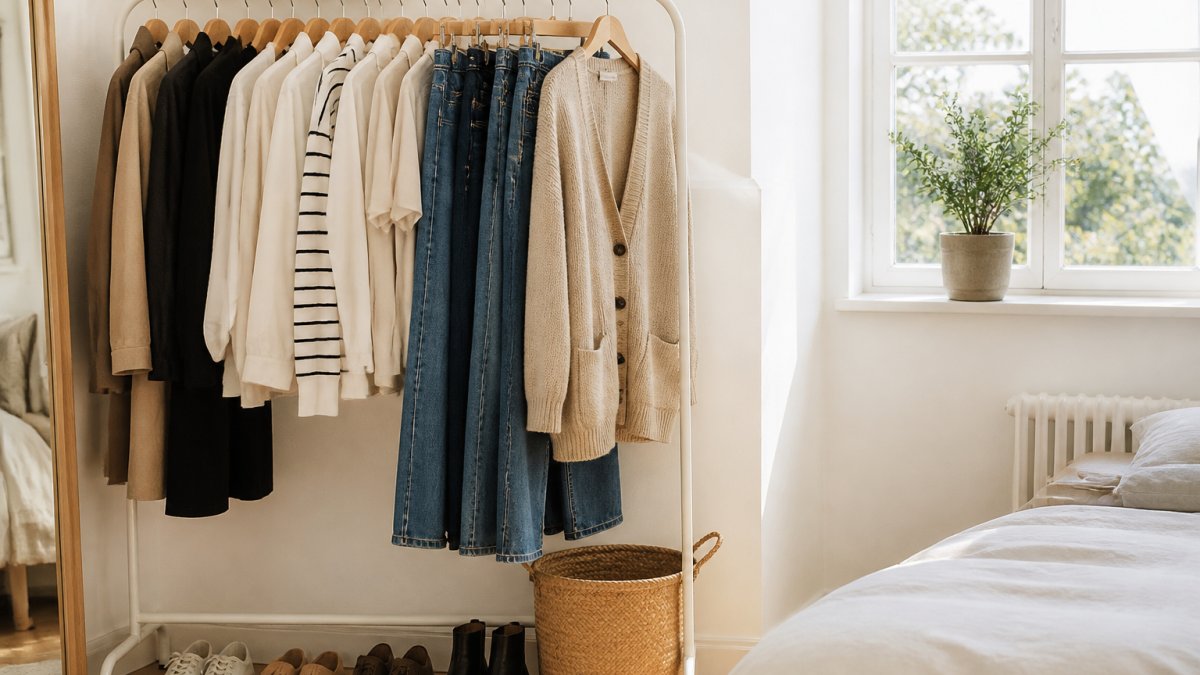
Tops, Bottoms, and Layers
Start with the pieces that touch your skin most often:
- 5 basic tees, in a mix of neutral and one or two accent colors
- 2 button-down shirts for work or layering
- 2 tanks for warm days and under-layers
Our Basic Bae Full Size Round Neck Short Sleeve T-Shirt does the heavy lifting here: sizes S through 3XL, a slightly stretchy rayon and spandex blend, and machine washable, which matters when a piece is in weekly rotation.

For denim, we like the Judy Blue Full Size Tummy Control Straight Jeans. The straight leg is the most versatile shape you can own, and this pair runs from size 0/24 through 24W.

Shoes and Accessories
Shoes and accessories are where most capsules quietly fall apart. People buy five pairs of statement shoes and one pair they can actually walk in.
Keep it to four pairs: white sneakers, a flat or loafer, a boot, and one heel or dressier option. Accessories do the rest of the work. A single belt, one structured bag, and two or three pieces of jewelry can shift the same outfit from errand-running to dinner.
Capsule Wardrobe Outfit Ideas: 10 Combinations from 20 Pieces
The test of a capsule is not how it looks on a rack but how many outfits it produces. Twenty well-chosen pieces should give you far more than twenty outfits, and the way there is a formula, not a memorized list.
Basic Bae Full Size Round Neck Short Sleeve T-Shirt →
The Three-Slot Formula
Every outfit is a stack of three decisions:
- Base, a top or a dress
- Bottom, pants, jeans, or a skirt (skip if you chose a dress)
- Layer or shoe, the piece that sets the dress code
If you have 8 tops, 4 bottoms, and 4 layers, you have 8 × 4 × 4 = 128 combinations before you even swap shoes. That is the math a capsule is built on. Most closets feel empty because the pieces do not share a palette, so the multiplication collapses.
Ten Combinations to Prove the Math Works
Work and Everyday
- Basic tee + straight jeans + open cardigan + loafers
- Button-down + tailored trousers + belt + flats
- Tank + cardigan + straight jeans + sneakers
- Button-down tucked into jeans + structured outer layer + boots
- Dress + cardigan + sneakers, for the days you cannot decide
Weekend and Game Day
- Basic tee + relaxed trousers + sneakers
- Ribbed tee + straight jeans + zip-up cardigan + boots
- Tank + open cardigan + jeans + white sneakers
- Tee + skirt + cardigan, layered for a cooler afternoon
- Game day look: team-color tee + jeans + open layer + comfortable shoes
That tenth one matters more than it looks. Sports fans often buy a separate set of clothes just for game days, which defeats the purpose of a capsule. A few tees in your team's colors slot into the same system as everything else. Our Double Take Open Front Long Sleeve Cardigan works over a game day tee, then again on Monday over a button-down.
A Simple Tracking System
A formula only works if you know which pieces are actually earning their space. Keep a one-page log for four weeks:
| Date | Base | Bottom | Layer/Shoe | Would Wear Again? |
|---|---|---|---|---|
| ___ | ___ | ___ | ___ | Y / N |
After four weeks, count how many times each piece appears. Anything worn fewer than twice is a candidate to swap out at the next seasonal review; anything worn more than eight times is a candidate to buy in a second color.
Cost Per Wear: A Budget Framework for Better Buying
Cost per wear is the most useful number in your closet, and almost nobody calculates it.
The formula is simple: price divided by the number of times you wear it.
A $15 tee worn 60 times costs you about 25 cents per wear.
| Item | Price | Wears per Year | Cost Per Wear |
|---|---|---|---|
| Basic tee | $15 | 60 | $0.25 |
| Ribbed tee | $17 | 40 | $0.43 |
| Straight jeans | $64 | 100 | $0.64 |
| Open cardigan | $36 | 80 | $0.45 |
| Zip-up cardigan | $43.99 | 50 | $0.88 |
The lesson is not "buy cheap" but "buy things you will actually repeat." A higher price on a piece you wear constantly beats a bargain on something that hangs untouched.
Maintain, Repair, and Refresh Your Capsule Wardrobe
A capsule degrades quietly: a hem comes loose, a tee stretches at the neck, a cardigan pills, and the pieces you relied on become the ones you avoid.
Set a maintenance rhythm:
- Monthly: check for loose seams, missing buttons, and stains before they set
- Seasonally: wash and store off-season pieces properly, and review what you did not wear
- Annually: replace the two or three pieces that are genuinely worn out
Care instructions matter more in a small wardrobe because each piece gets worn more often. Most pieces we carry, including our Basic Bae Ribbed Round Neck Short Sleeve T-Shirt, call for a cold machine wash and low tumble dry.

Refreshing does not mean replacing everything. It usually means swapping one or two pieces that have stopped earning their space, and adding one accent color to keep the palette from going stale.
Conclusion: Your Next 30 Days
The hardest part of building a capsule wardrobe is not the shopping but the honesty required to admit what you never wear.
If you would rather not rebuild from scratch alone, Peace Valley Boutique carries the basics that make a capsule function: full-size tees that fit a real range of bodies, straight-leg denim with tummy control, and open-front cardigans that layer over almost anything.
Frequently Asked Questions
What is the 3-3-3 rule for a capsule wardrobe?
The 3-3-3 rule is a simple starting formula: 3 tops, 3 bottoms, and 3 pairs of shoes that all work together. That gives you 27 possible outfit combinations without repeating. It is a low-pressure way to test whether a capsule approach fits your lifestyle before committing to a full closet edit. Many people use it as a travel packing method too. If you enjoy the process, expand to a 20-piece capsule using the checklist in this guide.
How many clothes should be in a capsule wardrobe?
Most capsule wardrobes land between 20 and 40 pieces, not counting underwear, sleepwear, or workout gear. A common starting point is 20 core items: about 8 tops, 5 bottoms, 3 layers, 2 pairs of shoes, and 2 accessories. The right number depends on your climate, dress code, and how often you do laundry. If you work from home, 20 pieces may be plenty. If you need office attire plus weekend wear, aim closer to 35.
How do I choose a color palette for a capsule wardrobe?
Pick two neutral base colors (black, navy, gray, beige, or white) and one or two accent colors you genuinely enjoy wearing. Every piece in your capsule should match at least two other pieces. A simple test: lay your chosen items on the bed and see if you can make five outfits without adding anything. If not, you are missing a bridge color or a layering piece. This method keeps outfit combinations high and decision fatigue low.
What are the essential pieces for a capsule wardrobe?
Start with well-fitting basics: two plain tees, one button-down, one pair of straight-leg jeans, one pair of tailored trousers, a cardigan or blazer, a neutral dress, and one pair of comfortable shoes. Add a second layer like a zip-up cardigan for cooler days. Quality matters more than quantity here. A $15 tee worn twice a week for a year costs about $0.14 per wear, which beats a $5 tee that pills after three washes.
How do you start building a capsule wardrobe without buying everything new?
Shop your closet first. Pull out every item you wore in the last two weeks and set them aside. Those are your proven favorites. Then fill gaps with a short shopping list, focusing on versatile pieces that match what you already own. Thrift stores and second-hand apps are good sources for trial pieces. You do not need to replace your whole wardrobe at once; a 30-day transition plan with one or two new items per week works well.
How do I make a capsule wardrobe work for different body types?
Focus on fit, not size labels. Choose pieces with some stretch, like jeans with 2% spandex or tees with a rayon blend, so they move with you. Straight-leg and tummy-control styles flatter a range of shapes. If you are between sizes, size up and tailor down. A capsule built on well-fitting clothes will always look better than one built on trends. Try each piece on and sit, bend, and reach before keeping it.